Every LOUKIENE system — pagers, walkie talkies, buzzers, and tour guide headsets — arrives pre-configured with no reprogramming required before first use.
Pager receivers and tour guide units both deliver 20 to 30 hours of continuous use on a full charge, outlasting a double shift or a full day of guided tours.
Transmitters and receivers across the pager line are waterproof and oil-resistant — built to handle kitchen spills, outdoor events, and the daily wipe-down that any food service surface gets.
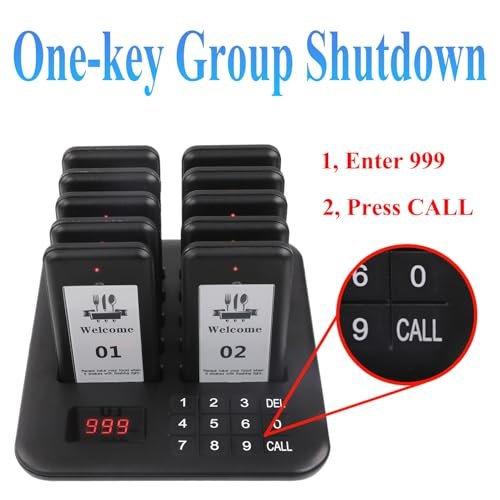
At closing time, enter 999 and press CALL on the transmitter to power down every pager on the charging base at once — no hunting down units one by one.
LOUKIENE's restaurant pager systems, kids walkie talkies, wireless quiz buzzers, and tour guide headsets each solve a different communication problem — but they all share the same out-of-the-box readiness that means you're running within minutes of opening the box.
Twelve pager system configurations spanning 10 to 26 pagers, in both flat beeper and coaster form factors, with 433MHz or 315MHz signal and fleet support up to 998 pagers per transmitter. Built for restaurants, food trucks, churches, and clinics.
LOUKIENE's kids walkie talkies give children ages 3–12 a real two-way radio experience — 22 channels, a built-in flashlight, and a 1.8-mile maximum range that covers a campsite or a neighborhood block without requiring a phone, Wi-Fi, or a charging cable hunt. ``` ```
LOUKIENE's wireless quiz buzzer system runs on 2.4GHz, locks out competing buttons the instant one player buzzes in, and reaches up to 262 feet — enough for any classroom, living room, or event hall. Available in 8-button and 10-button sets. ``` ```
LOUKIENE's wireless tour guide systems let one speaker's voice reach an entire group — no shouting, no cables, no AV crew. Three configurations cover groups from 6 to 30 receivers, with honest range and battery specs for factory floors, church halls, museums, and classroom training. ``` ```
Browse the complete brand catalog with up-to-date pricing on Amazon.
These twelve are the most-reviewed and highest-rated products across the pager, walkie talkie, buzzer, and tour guide lines — chosen because their specs match specific, common scenarios rather than because they're the cheapest option in the category.
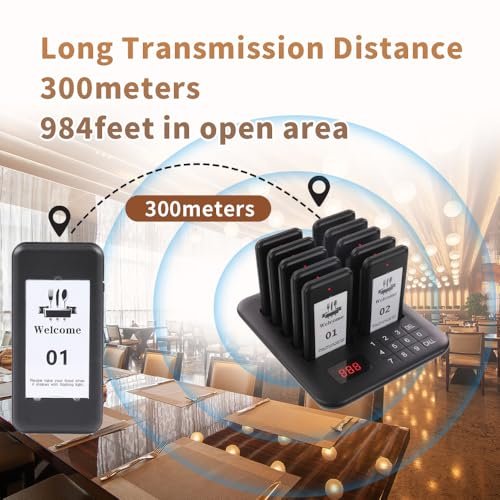
LOUKIENE's restaurant pager line covers 10 to 26 pagers in two distinct form factors: flat rectangular beepers (4.1 × 1.9 × 0.39 inches) with a mute button, and round coaster pagers (about 3.15 inches in diameter) with 7 configurable alert modes. All systems operate on 433MHz or 315MHz, reach up to 984 feet in open area, and ship pre-paired with no programming required. The two architectures matter: beeper models max out at 98 pagers per transmitter, while coaster models support fleets up to 998 or 999 units — a real distinction if you're running a large venue or planning to grow.
The right LOUKIENE pager system depends on two things: how many customers you're managing at peak hours, and whether you want a traditional flat beeper or a disc-shaped coaster pager. Most food trucks and small cafés are well-served by a 10- or 16-pager beeper setup. Medium dinner-service restaurants typically need 20 pagers. High-volume or growing operations should look at the coaster line for its larger alert-mode range and 998-pager fleet capacity.
The flat beeper models (LK-P1B10, LK-NF916, LK-F101, LK-F103, LK-F103W, LK-P1B106) measure 4.1 × 1.9 × 0.39 inches — slim enough to fit in a pocket or sit on a small table. Each one has a mute button on the side so the customer can silence the alert themselves. They run 20 hours on a full charge and offer 2 prompt mode combinations: buzzer + vibrate + flash, or vibrate + flash only.
The coaster pagers (LK-QCB20, LK-QCB09) are disc-shaped, roughly the size of a drink coaster. They trade the mute button for 7 configurable alert combinations — off, slow, normal, or fast vibration, flash-only, buzz-only, or any combination you want. Battery standby on the coaster line is 14 hours, not 20. That's a real difference if you run a long double shift without putting pagers back on the base between service periods. On the other hand, the coaster transmitters support up to 998 or 999 pagers per base, giving you room to grow without replacing hardware.
Food truck or small café (up to 10 tables): The 10-Pager Touch Keyboard Starter (LK-P1B10) is the most-reviewed model in the line at 4.3 stars across 128 reviews, and it handles up to 998 pagers if you ever expand. Start here.
Mid-size café or casual restaurant (10–16 tables): Either the 16-Pager Beeper System Black (LK-F101) at 315MHz or the 16-Pager Many-to-One System (LK-NF916) at 433MHz. The LK-NF916 adds many-to-one support — useful if you want a counter keyboard and a kitchen keyboard both calling the same pager fleet. Note: both cap at 98 pagers maximum, so they're not the right pick if you plan to scale past that.
Full dinner-service restaurant (16–20 tables): The 20-Pager Beeper System Black (LK-F103) or White (LK-F103W) — both rated 4.4 stars across 56 reviews, the highest rating in the pager line. Same 433MHz frequency, same 98-pager fleet cap, same 20-hour standby. Pick black or white based on your front-of-house aesthetic.
High-volume or expanding operation: The 20 Coaster Pager System (LK-QCB20) supports up to 998 pagers, delivers 7 alert modes for noisy environments, and uses a sealed seamless transmitter keyboard that wipes clean without liquid getting into the keypad. The 10 Coaster Pager Quick Pair (LK-QCB09) does the same job at a smaller starting count, adds calling history (last 10 numbers logged), and includes an independent quick pairing slot so replacement pagers are live in seconds.
This trips people up more than anything else in the line. Models with a 98-pager cap (LK-NF916, LK-F101, LK-F103, LK-F103W) are fine for single-location restaurants — most operations never exceed 30–40 active pagers. But if you're running multiple transmitters across a large venue, or planning to add pagers as you grow, the 998-pager cap models give you flexibility you won't regret having.
One last thing worth saying plainly: the LK-R20 and LK-R26 round coaster models are rated 3.4 stars — the lowest in the LOUKIENE catalog. They share the same core specs as the better-rated coaster models but have a thinner, smaller disc form factor (3.15 × 0.43 inches). If you're choosing between coaster styles, the LK-QCB20 and LK-QCB09 have meaningfully stronger review scores.
LOUKIENE pager systems ship pre-paired — the pagers and transmitter already know each other out of the box. There's no programming sequence to run before first use. The single step that catches most buyers is this: charge every pager for 3–4 hours before you page anyone. Pagers pulled from the box and used immediately will behave erratically, and that gets blamed on the hardware when it's actually a battery issue.
Every LOUKIENE beeper-style pager defaults to the full alert combination — buzzer + vibrate + flash. To switch to vibrate + flash only (no audible beep), press the mute button on the right side of the pager once while it's active, or consult your specific model's setting procedure. On the LK-P1B106 (16-Pager 250mAh Touch Keypad), the mode toggles between two options: flash + beep + vibrate, or flash + vibrate only.
A note from a real operator situation: a food truck owner on Reddit's r/foodtrucks forum had a Loukiene pager where the beep had gone silent — turned out someone had accidentally toggled the alert mode to vibrate-only. If your pager buzzes but you can't hear it, this is almost certainly the cause, not a hardware failure. Run through the mode-switching procedure once and you'll have it back.
At closing time, the fastest way to power down the entire pager fleet is the group shutdown command. The exact code varies by model:
Pagers must be pre-paired with the transmitter for the shutdown command to reach them. If you've recently replaced a pager and haven't paired it yet, the shutdown command won't affect it.
Adding a new pager or re-pairing one that lost its assignment takes under a minute. On beeper-style models: press the stop button and the metal button on the pager simultaneously — two lights on the right side will illuminate. Then enter the desired pager number on the transmitter keyboard and press CALL. The pager buzzes once to confirm. Done.
On coaster models (LK-QCB09 specifically), the quick pairing slot on the transmitter handles this automatically — place the new pager in the dedicated slot, follow the on-screen prompt, and it's assigned without touching the keypad at all.
If you're running multiple transmitters in the same space — one at the front counter, one in the kitchen — you'll need to set each transmitter to a different ID so they don't interfere with each other. On most models: press DEL + CALL simultaneously, and the screen shows F1. Press CALL again, and the current ID number flashes. Enter your desired ID (001–998 depending on model) and press CALL to confirm. The new ID saves immediately.
Retekess is the most visible competitor in the restaurant pager space — they show up on nearly every pager-related search result alongside LOUKIENE. If you've been looking at both brands, here's where the differences actually show up in day-to-day use.
The most meaningful technical difference between the two brands at similar price points comes down to how many pagers a single transmitter can handle. LOUKIENE's 998-pager cap models (LK-P1B10, LK-QCB20, LK-QCB09, LK-P1B106) support nearly 1,000 pagers per transmitter. Retekess's entry and mid-range models — including the TD177, one of their most frequently compared units — typically cap at 99 pagers per transmitter. For most single-location restaurants, 98 vs. 998 makes no practical difference. For a large food court, a hotel with multiple F&B outlets, or any operation planning to run multiple transmitters calling the same pager fleet, the LOUKIENE cap gives you room that Retekess's standard hardware doesn't.
Retekess pagers generally offer buzz, vibrate, and flash alerts in fixed or limited combinations. LOUKIENE's coaster-style models (LK-QCB20, LK-QCB09) offer 7 configurable combinations — including flash-only, vibrate-only, slow-flash, fast-flash, and stacked combinations. LOUKIENE's beeper-style models offer 2 combinations. If alert customization matters to your venue — a quiet tearoom needs something different than a loud outdoor food festival — the coaster line gives more options than either brand's standard beeper hardware.
Both brands ship pre-paired. Neither requires programming software or a computer to get started. LOUKIENE's beeper-style pagers have a physical mute button on the right side that lets customers silence their own pager — Retekess's coaster pagers generally don't. The LOUKIENE coaster models drop the mute button but add the 7-mode alert configuration, so it's a tradeoff rather than one being strictly better.
Honesty matters here. Retekess has a longer documented review history and more SKUs in the market — their TD177 and similar models have accumulated thousands of reviews over several years. LOUKIENE's most-reviewed model (LK-P1B10) sits at 128 reviews. If review volume gives you confidence in a purchase, Retekess has the larger track record at this point. LOUKIENE's 4.3-star average on the LK-P1B10 is competitive, but it's based on fewer data points.
The flip side: LOUKIENE's pager line includes the 998-pager fleet cap at starting counts where Retekess still uses a 99-pager cap, the one-touch group shutdown (enter 999 + CALL powers off every pager on the base simultaneously), and a sealed seamless transmitter keyboard design that resists liquid infiltration — relevant in a kitchen environment where the transmitter gets wiped down multiple times a shift.
For a small restaurant or food truck starting at 10–20 pagers with no plans to scale a large fleet: either brand works. Look at the specific model specs for the alert mode setup and mute-button availability that fits your service environment. For operations that need to grow a fleet past 99 pagers, run multiple transmitters on a shared fleet, or want 7-mode alert configuration on coaster-style hardware — LOUKIENE's architecture handles those use cases without requiring a hardware upgrade.
We picked this walkthrough because it shows our 20-coaster pager system in the kind of real-service context that spec sheets can't replicate. You'll see the buzz, vibrate, and flash alert modes in action — not just described. If you're deciding between our 10-pager and 20-pager kits for a food truck, café, or church nursery, watch this before you choose.
"We run a food truck at weekend markets and the 10-Pager Touch Keyboard Starter has held up for about eight months now without a hiccup. Range covers the entire parking area — customers wait at their cars and we page them when their order's bagged. Only complaint is the standby LED keeps flashing when pagers aren't docked, which confused a couple of customers at first."— Darnell K., food truck operator (Austin, TX), on Restaurant Pager System
"We switched from a competitor's 16-pager to the 20-Pager Beeper System (Black) at our café. The 20-hour battery is the real win — we run a double shift on weekends and never once had a pager die mid-service. The mute button matters more than I expected: quieter dining room, happier regulars."— Teresa M., café owner, on Restaurant Pager System
"Bought the 20 Coaster Pager System for our church nursery pickup. The seven alert modes are genuinely useful — we run vibration-only during the service so the sanctuary stays quiet. Setup took about ten minutes total. My one gripe is the 14-hour standby versus the beeper models' 20 hours, but for a single Sunday session it's never been a problem."— Rachel B., church coordinator, on Restaurant Pager System
"Our kids used the Kids Walkie Talkie Pair (Red/Green) across a full weekend camping trip. The VOX hands-free mode worked well once we figured out the sensitivity setting — level 2 was the sweet spot in the woods. Range through trees was maybe 300–400 feet realistically, not the rated mile-plus, but it covered our campsite comfortably. My 7-year-old figured out push-to-talk in about two minutes."— Marcus P., parent (kids ages 7 and 10), on Kids Walkie Talkie
"Running weekly pub trivia for about 30 people, and the Quiz Buzzer 10-Button Set has been solid for three months. The lockout works exactly as advertised — first press locks everyone else out until I hit reset on the remote. Volume goes high enough that the bar noise doesn't drown it out. Only limitation: buttons need AAA batteries, so I keep a spare pack behind the bar."— Simone W., bar trivia host, on Wireless Quiz Buzzer System
"We do factory floor tours roughly twice a week for visiting clients. The Tour Guide 15-Receiver System solved the 'shouting over machinery' problem immediately. The 100g transmitter is light enough that I forget it's clipped on. Battery ran comfortably through a 4-hour tour day with charge to spare. Wish the receivers had slightly larger volume wheels for people who struggle with small controls."— Greg T., facility tour coordinator (manufacturing), on Wireless Tour Guide System
The system ships pre-paired — no programming required. Place the base transmitter on your counter, charge the pagers for 3–4 hours before first use, then enter the pager's assigned number on the touch keyboard and press CALL. The pager alerts the customer via buzz, vibration, flash, or any combination of the three. When the customer silences it using the mute button, the alert stops.
Yes — widely. Many quick-service restaurants, food trucks, church nurseries, clinics, and hotel lobbies still rely on pager systems because they don't require a customer's phone number, don't depend on cell service, and work without a smartphone app. LOUKIENE's pager line supports up to 998 pagers per transmitter, which covers most operations from a 10-table café to a large food court.
The rated range is 984 feet (300 meters) in open area. Through standard restaurant walls — drywall and wood construction — expect reliable paging at 200–300 feet. Multi-floor venues with concrete slab floors will see shorter range. For most single-story restaurants and food trucks, 984 feet rated means you won't lose a pager signal in the dining room or parking lot.
Beeper models (LK-P1B10, LK-F101, LK-F103 series) are rectangular, include a mute button on the pager itself, offer 2 alert mode combinations, and run 20 hours on a charge. Coaster pager models (LK-QCB20, LK-QCB09) are disc-shaped, offer 7 alert mode combinations, but run approximately 14 hours per charge and don't include a customer-facing mute button. The right choice depends on your venue and whether you want more alert flexibility or longer standby.
Both LOUKIENE kids walkie talkie models (LK-T388RG and LK-H628) are rated for 1.8 miles (3 km) — that figure applies to flat, obstacle-free terrain. In realistic outdoor use through trees, suburban houses, or campsite terrain, expect 300–600 feet of reliable signal. That comfortably covers a campsite, a park block, or opposite ends of a neighborhood yard. Dense wooded areas reduce range further.
Yes. Both models operate on standard FRS/UHF frequencies and comply with FCC Part 15 rules for consumer radio devices. The keylock feature — available on both the LK-T388RG and LK-H628 — prevents children from accidentally changing channels or unpairing. At 110g per unit, they fit small hands comfortably. Neither model transmits more power than any standard FRS consumer radio.
Not if you use CTCSS codes. Both LOUKIENE walkie talkie models include 99 CTCSS codes — think of them as sub-channel filters. When your radios are set to the same channel and the same CTCSS code, transmissions from other users on that channel won't break through unless their radio matches your exact code. It doesn't encrypt the signal, but it prevents casual crosstalk in busy areas like campgrounds.
Yes. The LOUKIENE Quiz Buzzer 10-Button Set and 8-Button Set both use 2.4GHz wireless with a lockout mechanism — the first button pressed locks all other buttons on the display unit until the host resets using the included remote. The remote controls Start, Timing, and Reset. Three operating modes (normal, voice, and elimination) let you customize gameplay for different formats, and the system supports expansion up to 32 buttons.
For family game nights, bar trivia, and classroom contests, no — the 2.4GHz signal delivers response times well under any perceptible human reaction window. Competitive quiz bowl events where milliseconds determine a winner do exist, and in those contexts wired systems have a measurable physical advantage. But for the vast majority of trivia and game-show use cases, the LOUKIENE 2.4GHz system is fast enough that lag won't factor into any disputed buzzer call.
One transmitter can pair with an unlimited number of receivers on the same channel — there's no hard cap built into the hardware. The LOUKIENE tour guide line ships in three kit sizes: 6 receivers (LK-7T/R6), 15 receivers (LK-7T/R15), and 30 receivers (LK-7T/R30). Each includes the corresponding charging station. The 30-receiver kit also includes a storage case, which matters for operations running multiple tours daily.
The transmitter carries a 3,000mAh battery with 24–30 hours of continuous use. Each receiver runs 24–30 hours on its 300mAh battery. A full charge takes 3 hours via Type-C for both units. That math works out to multiple full-day tours on a single overnight charge — useful for museum operations or factory facilities running back-to-back visitor groups.
Yes — every LOUKIENE product across all four lines ships pre-paired and requires no reprogramming before first use. Pager systems need a 3–4 hour initial charge before the pagers perform reliably. Walkie talkies require batteries (AAA for the LK-T388RG, AA for the LK-H628 — neither included). Tour guide systems and quiz buzzers charge via Type-C and are ready after a full charge cycle.
LOUKIENE started where most wireless communication problems are most visible: the restaurant floor. The pager line — now 12 products spanning everything from a 10-pager food truck starter to 26-pager coaster systems — was built around a specific frustration. Operators were buying wireless paging hardware, reprogramming it wrong, getting erratic results, and blaming the technology when the real problem was a setup process nobody had designed for non-technical users. LOUKIENE's answer was simple: ship it pre-paired. Every pager system in the line works straight out of the box, no programming required — just charge for 3–4 hours and hand pagers to customers.
That same philosophy shaped the other three lines as they developed. The kids walkie talkie line applies it to a completely different buyer: parents who don't want a manual, a programming session, or a VOX sensitivity adjustment before their kids can use the radios at a campsite. Push-to-talk, 22 channels, 99 CTCSS codes, and a keylock for small hands — done. The wireless quiz buzzer system took the same principle into classrooms and game nights: 2.4GHz lockout that works without calibration, three game modes selectable from the remote, and a display that shows the winner's number the moment someone buzzes in. The wireless tour guide system — available in 6-, 15-, and 30-receiver configurations — extends the reach to factory tours, museum groups, and church interpretation setups where a guide needs their voice in every listener's ear without cables, carts, or a sound technician.
The four lines serve entirely different buyers and different situations, but they share a recognizable character: hardware that people without wireless engineering backgrounds can configure in minutes, specs stated honestly (the 984-foot pager range is an open-area figure, not a through-wall guarantee), and designs built to survive service environments — waterproof and oil-resistant where it matters, lightweight where weight affects how long someone wears the device. LOUKIENE isn't trying to be the highest-spec option in any of these categories. It's trying to be the one that works on the first day and keeps working.
Straight answers to the questions your customers actually ask about pagers, walkie talkies, and quiz buzzers.
LOUKIENE makes wireless communication systems across four distinct product lines: restaurant pager systems, kids walkie talkies, wireless quiz buzzer systems, and wireless tour guide systems. Every product in the lineup is sold through the official LOUKIENE Store on Amazon, where the full catalog — all 17 current models — is available with current pricing and in-stock information.
For product questions, setup assistance, or issues after purchase, reach LOUKIENE directly through Amazon's buyer-seller messaging system on your order page. LOUKIENE responds to support requests through that channel across all product lines. Replacement pagers for the restaurant pager systems can be paired to an existing transmitter without reprogramming — the pairing procedure is covered in the product instructions included with each kit.
The kids walkie talkie line (LK-T388RG and LK-H628) and all three wireless tour guide systems carry a 2-year manufacturer warranty. For restaurant pager systems and quiz buzzer systems, refer to the warranty terms listed on the specific Amazon product page. Returns and refunds follow Amazon's standard return policy for fulfilled orders — check your order details for the applicable return window.