LOUKIENE Wireless Tour Guide Systems for Groups
LOUKIENE tour guide systems deliver one speaker's voice clearly to every participant in the group — whether that's a factory floor walkthrough, a church translation session, a museum tour, or a corporate training day. Each system ships with a transmitter the guide wears or carries, lightweight receivers participants clip to a collar or pocket, and both a straight microphone and a headset microphone so the guide can work hands-free or handheld.
Three configurations cover groups of 6, 15, or 30 receivers. All three run on included lithium-ion batteries, connect via RF (no Wi-Fi required), and include noise reduction and a mute function on every unit. Pick the receiver count that matches your typical group size — you're not locked in, but you can't add receivers to a kit that doesn't support them.

Choose Your Group Size
Tour Guide 15-Receiver System
See on Amazon
Tour Guide 6-Receiver Starter
See on Amazon
Tour Guide 30-Receiver Kit
See on AmazonKit Configurations Side by Side
All three kits share the same RF connectivity, noise reduction, and battery-powered design. The differences that actually matter for buying are receiver count, connector type, rated range, and what ships in the box.
| Model | Receivers | Transmitter Connector | Rated Range | Clip Feature | What's in the Box | Best For |
|---|---|---|---|---|---|---|
| B0FVXQKM67 | 6 receivers + 1 transmitter | 3.5mm jack | Up to 164 ft (50 m) | No | Transmitter, 6 receivers, 1 charger | Small training groups, shift-rotation tours, intimate church translation |
| B0DJSNN387 | 15 receivers + 1 transmitter | USB Type-C | Up to 328 ft (100 m) | Yes (transmitter) | Transmitter, 15 receivers | Standard museum tours, factory walkthroughs, mid-size congregation translation |
| B0FVXRXKN8 | 30 receivers + 1 transmitter | USB Type-C | Up to 328 ft (100 m) | Yes (transmitter) | Transmitter, 30 receivers, 1 charger, 1 storage case | Large training cohorts, conference interpretation, school field trips |
If your group regularly runs between 10 and 15 people, the 15-receiver kit is the right call — the extended 328-foot range and USB Type-C charging make it the more practical daily-use system. Reserve the 6-receiver kit for situations where portability and lower receiver count genuinely match your setup.
How to Pick the Right Kit for Your Group
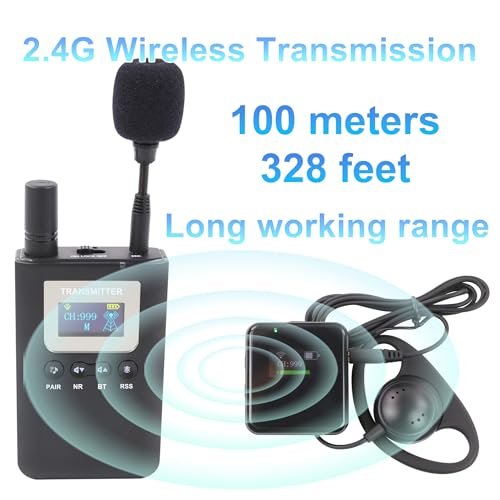
The first decision is receiver count. The 6-receiver kit suits small training groups, intimate walking tours, or situations where you rotate the same six headsets through a larger crowd in shifts. The 15-receiver kit is the sweet spot for most guided tours, factory walkthroughs, and church translation setups — enough units for a standard group without the bulk of carrying 30 receivers you may not need. The 30-receiver kit handles larger training cohorts, conference interpretation setups, and museum tour groups where you genuinely need everyone wearing a headset simultaneously.
Connection type is worth checking before you buy. The 6-receiver kit uses a 3.5mm jack on the transmitter — compatible with most lavalier and headset microphones you may already own. The 15-receiver and 30-receiver kits both use USB Type-C charging, which simplifies keeping everything powered between sessions. All three kits use RF (radio frequency) connectivity, which means they operate independently of any venue Wi-Fi network — a real advantage in factories, basements, and older church buildings where wireless infrastructure is unreliable.
Consider what your guide is doing during the session. If they're pointing at machinery, handling materials, or moving through a production line, the headset microphone included with each kit frees both hands. If the guide stands mostly in place — a lecturer at the front of a room, a court interpreter at a table — the handheld straight microphone works fine. Both come in the box, so this isn't a separate purchase either way.
- Group of 6 or fewer: The 6-receiver kit is the right fit — lighter to carry, simpler to manage, no unused equipment.
- Group of 7–15: The 15-receiver kit covers this range and includes a storage case that keeps everything organized between uses.
- Group of 16–30: The 30-receiver kit is the only option that goes this large; it ships with a charger and a storage case sized for all 30 receivers.
- Multi-language settings: Each kit supports channel selection, so different language groups can run on separate channels simultaneously using multiple transmitters without interference.
Real Scenarios Where These Systems Work
Factory floor tours are one of the most demanding environments for any wireless audio system — high ambient noise, metal equipment that bounces and absorbs signal, and a group that's constantly moving in relation to the guide. The LOUKIENE transmitter's noise reduction helps cut through background machinery noise, and the RF connection doesn't depend on the facility's network. The guide clips the transmitter to their belt, puts on the headset microphone, and every participant hears clearly through their receiver regardless of where they are in the group.
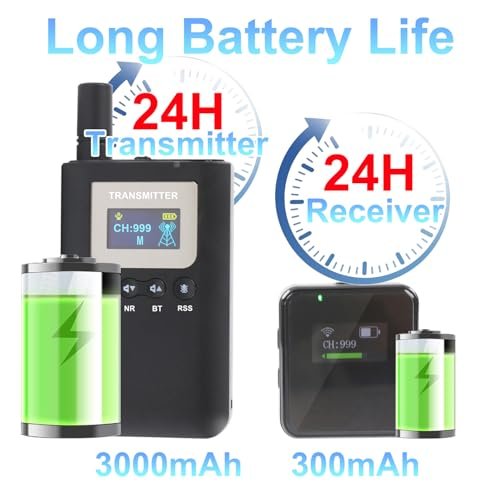
Church translation setups often run during live services, which means the guide can't pause or repeat themselves — the participants' receivers have to keep up in real time. The mute function on both transmitter and receiver lets the interpreter cut their own feed when needed without fumbling. Volume control on each receiver means participants adjust to their own preference without signaling the guide. For a small congregation with one or two interpretation channels, the 6-receiver kit handles a typical session. Larger multilingual congregations regularly run the 15- or 30-receiver kit for the primary language group.
Museum and heritage site tours benefit from the transmitter's clip-on form factor — guides already carry enough (maps, radios, phone) and a 3.5 oz transmitter on a belt clip adds nothing meaningful to that load. Participants clip their 1 oz receiver to a jacket or lanyard and move freely within the group. The rated range — up to 164 feet on the 6-receiver kit, up to 328 feet on the 15- and 30-receiver kits — covers gallery-to-gallery movement in most museum floor plans without signal loss.
- Corporate training rooms: Row seating up to 30 participants, trainer moves freely, no lapel mic stand required.
- Outdoor walking tours: RF signal handles open-air use; stay within the rated range and crowd density doesn't degrade the signal.
- Courtroom and legal interpretation: Mute function lets interpreters pause cleanly; individual volume control keeps each listener comfortable.
- School field trips: Lightweight receivers are easy for students to carry; clip attaches to a backpack strap or collar.
Battery, Charging, and Keeping the Kit Ready
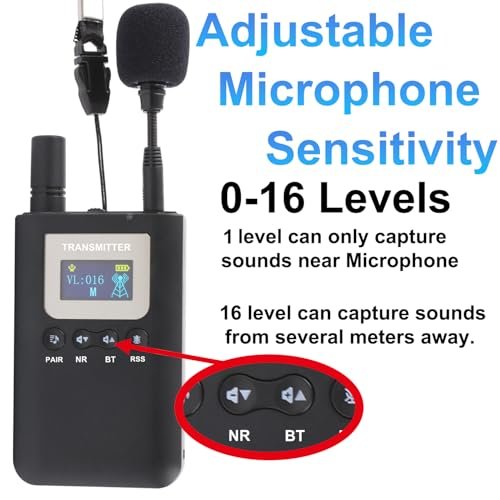
Every unit — transmitter and all receivers — runs on an included lithium-ion battery. No AA or AAA batteries to stock. Charge the transmitter and receivers before each use session; the 3-hour charge time on these units means a charge the night before a morning tour or during a lunch break before an afternoon session is enough. Don't wait until the morning of to plug everything in — if you're running the 30-receiver kit, that's 31 units to charge.
The 30-receiver kit ships with a charger designed for the full set, and the storage case keeps everything in one place between sessions. If you're running the 15- or 30-receiver kit in a venue you visit regularly — a factory you tour weekly, a church you serve every Sunday — designate a charging spot in the building so the kit is always topped off and ready. The 6-receiver kit is compact enough to carry in a shoulder bag; keeping a small charging station at your desk or in an equipment locker works fine for that configuration.
- Charge before every session, not just when the battery indicator drops — lithium-ion batteries perform best when kept above 20%.
- Store receivers clipped or cased, not loose in a drawer — the clip mechanism is the most common wear point on lightweight receivers.
- Check the mute switch before distributing to participants — a receiver that was muted at the end of the last session and handed out unmuted will cause confusion immediately.
- Wipe down receivers between users with a dry or lightly damp cloth — the headsets are shared equipment and benefit from basic hygiene maintenance.
- Test the channel assignment before participants arrive if you're running multiple transmitters simultaneously; channel conflicts between kits are the most common setup issue and take about 30 seconds to resolve.
Frequently Asked Questions
Do I need Wi-Fi or an internet connection to run these systems?
No. All three LOUKIENE tour guide kits use RF (radio frequency) wireless connectivity, which operates completely independently of any Wi-Fi network or cellular signal. That matters in factories with blocked wireless networks, basements, older church buildings, and outdoor sites where no network infrastructure exists. You turn on the transmitter, turn on the receivers, and the signal is live — no network login, no app, no router required.
What's the realistic range inside a building, not just the rated maximum?
The 6-receiver kit is rated up to 164 feet (50 meters). The 15- and 30-receiver kits are rated up to 328 feet (100 meters). Both figures apply to open-area conditions. Inside a building, thick concrete walls, metal shelving, and dense equipment will reduce effective range — in a typical factory or museum with standard construction, expect reliable signal to 60–150 feet through interior spaces with multiple walls. For most gallery-to-gallery or room-to-room tour scenarios, that's sufficient. If your venue has unusually heavy construction or you're moving through multiple concrete floors, test the range in your specific space before committing to a session with participants.
Can I run two transmitters at the same time for different language groups?
Yes. Each kit supports channel selection, which lets you run multiple transmitters simultaneously on separate channels without interference between groups. Participants in language group A tune their receivers to channel A; group B tunes to channel B. This is standard practice for multilingual church services and international conference interpretation setups. Assign channels before participants arrive to avoid confusion during distribution.
How long does the battery last, and how long does it take to charge?
Each unit — transmitter and receivers — charges in approximately 3 hours from a depleted state. Battery life on a full charge covers a standard tour or training session; for all-day use with multiple sessions, plan a midday charge during any break of 30 minutes or longer. The 30-receiver kit ships with a dedicated charger for managing the full set. Charge the night before for a morning session rather than scrambling to charge the same morning — 31 units need time.
What microphone options does the guide have?
Each kit includes both a straight (handheld) microphone and a headset microphone. Guides who move through a production line, handle materials, or gesture frequently during the tour use the headset to keep both hands free. Guides who stand mostly in place — a trainer at a whiteboard, an interpreter at a table — may prefer the handheld. Both microphones are included in the box; you don't need to purchase accessories separately to get either option.
Is the 30-receiver kit just 30 individual units to track, or does storage come with it?
The 30-receiver kit ships with a storage case sized to hold the full set — transmitter, all 30 receivers, and the charger. That's a meaningful difference from the smaller kits if you're managing shared equipment across multiple sessions. The case keeps everything in one place, reduces the chance of receivers going missing between uses, and makes transport to off-site venues straightforward. The 15-receiver kit ships without a dedicated case; for regular off-site use with that configuration, a padded equipment bag is worth adding separately.